Navigate to my Write-Ups Here!

Thanh Nguyen
LOS ANGELES (OPEN TO RELOCATE)
Data Analyst
business strategy
Python | SQL
Excel | tableau
1.5 YOE INTERN
DATA SCIENCE
cr associates
CONSULTING
Spotify For Emerging Artists
Executive Summary
This report analyzes 16 years of Spotify data to identify market trends, track performance, and algorithm mechanics. The current music ecosystem is highly concentrated, presenting systemic barriers for emerging talent to break into main stream. By evaluating single vs. album performance and algorithmic behaviors through track ranking, this study delivers data-backed insights to protect long-term platform health and provide structured support for emerging artists.
EDA and Background
The current Spotify ecosystem is highly concentrated. Emerging talents face systemic barriers to entry into the mainstream catalog, driven by algorithm mechanics that heavily favor established, high-performing artists.
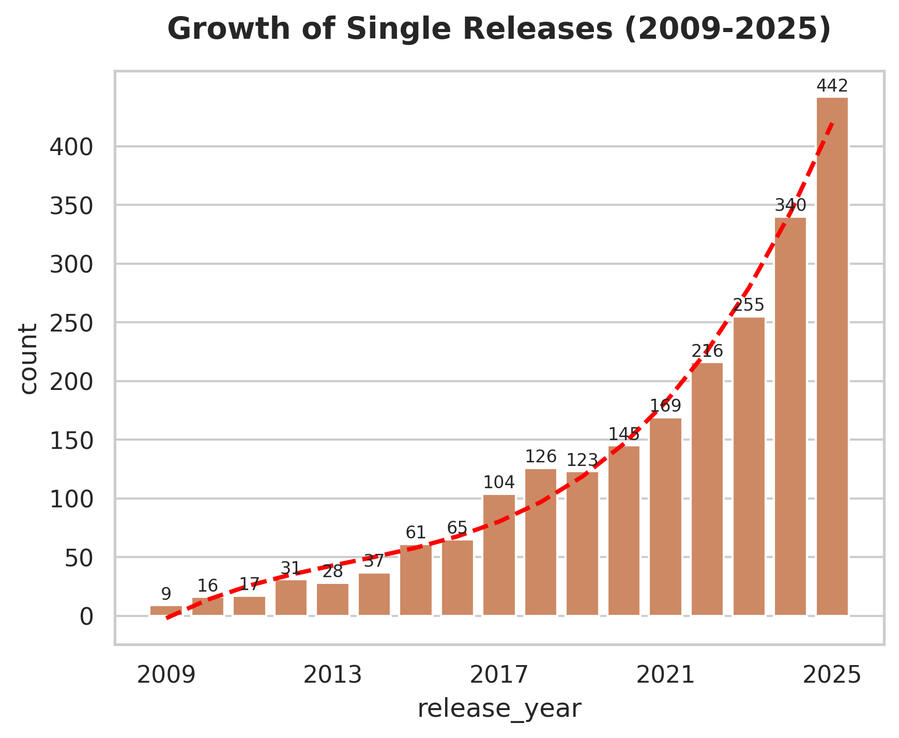
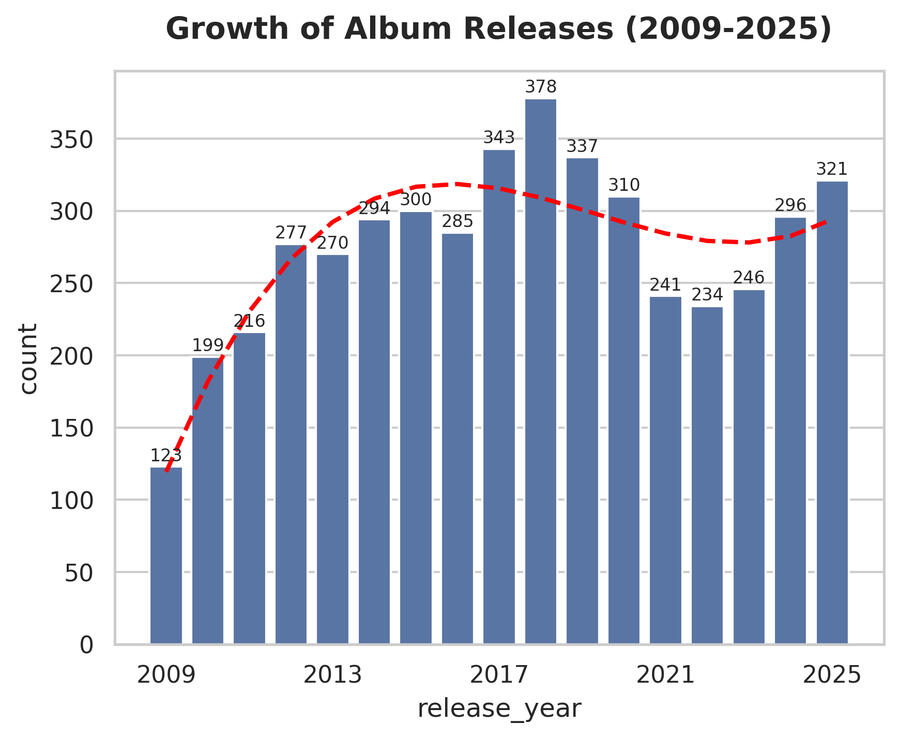
The trend of releasing music as standalone singles has risen exponentially with no sign of slowing down. In 2025 alone, 121 (+137%) more tracks were released as singles than albums.
How Popularity Ranking Works
Scale Mechanics: Spotify utilizes a non-linear, exponential 0–100 Popularity Score. A jump from 50 to 70 represents a massive spike in actual listenership.
Core Drivers: Calculations heavily favor short-term listening metrics: rolling 30-day play counts, engagement ratios (saves/playlist additions), and low skip rates.
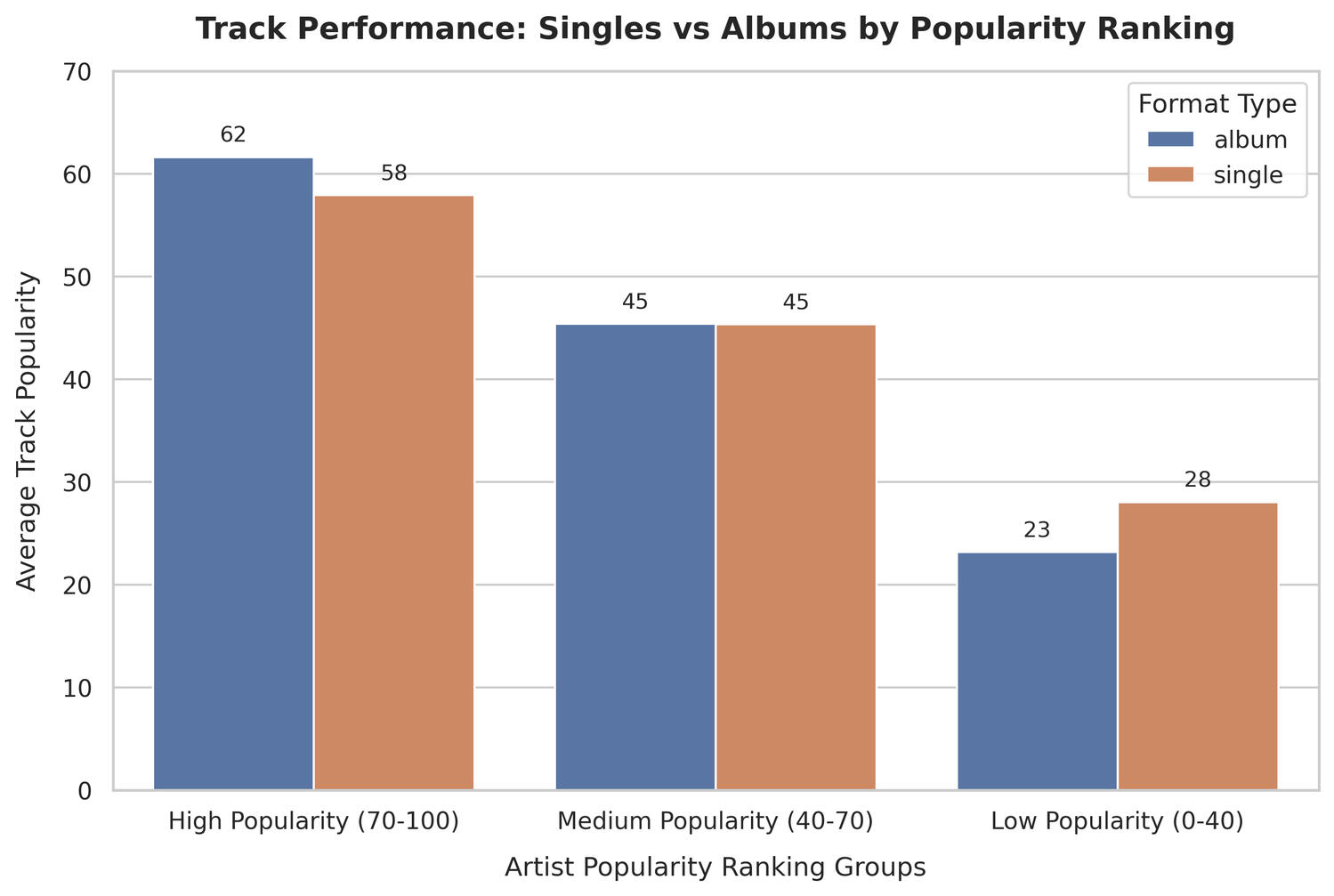
Singles Outperform Album Releases for Emerging Artists
For lesser-known names, full album releases underperform. Singles act as low-friction entry points where consistent releases trigger algorithmic pushes to new audience.
Medium-tier artists maintain a stable baseline audience. Strategy at this tier can be dictated by creative preference rather than structural optimization.
Established well-known superstars possess dedicated, active fanbases that consume albums on release days. For them, singles underperform compared to albums.
Popularity Ranking is Skewed in Favor of Established Artists
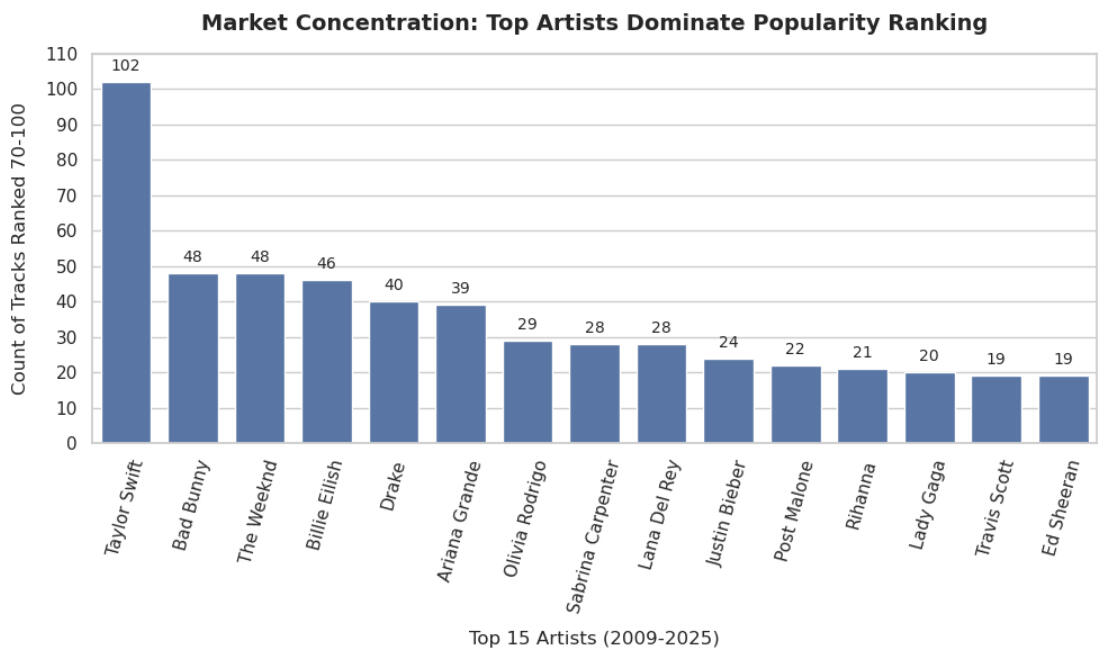
The Outlier: Taylor Swift leads with 102 high-ranking tracks, accounting for nearly 20% of the entire Top 15 inventory and outperforming her closest rivals Bad Bunny and The Weeknd by more than double (+112.5%).
Top 15 Dominance: Out of 1,927 total tracks that achieved an a high rank (popularity between 70 and 100), just 15 individuals command 533 of them (almost 30% of the whole market).
Significance: Playlist algorithms heavily favor a small group of legacy acts. Emerging artists face an steep uphill battle securing placements in major editorial playlists.
Mainstream Concentration and Clusters
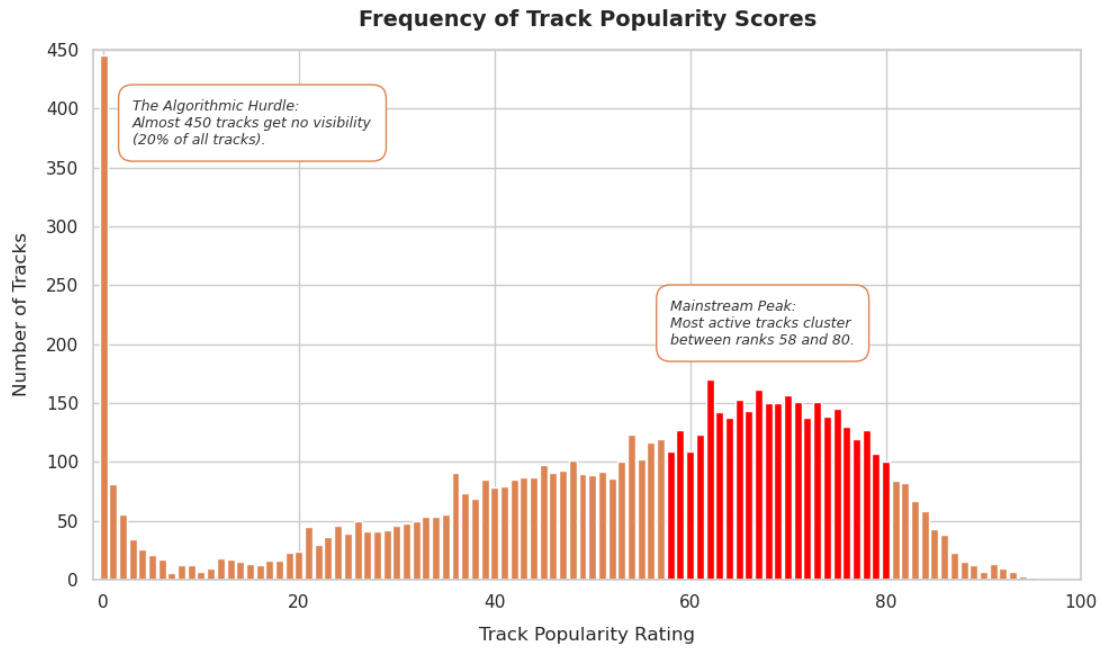
Algorithmic Gatekeeping: The massive spike at 0 strongly supports the earlier insight that emerging talent faces an uphill battle against Spotify's recommendation algorithm.
The Mainstream Peak: Once a track breaks past initial barriers, it tends to cluster in a moderately high popularity zone (between 58 and 80). Few artists produce tracks that rank between 80 and 100.
The Emerging Artist Threshold: Dramatic drop in tracks between ranks 0-20, but a steady rise between ranks 20-58.
Likelihood of an Emerging Artist Making it to Mainstream
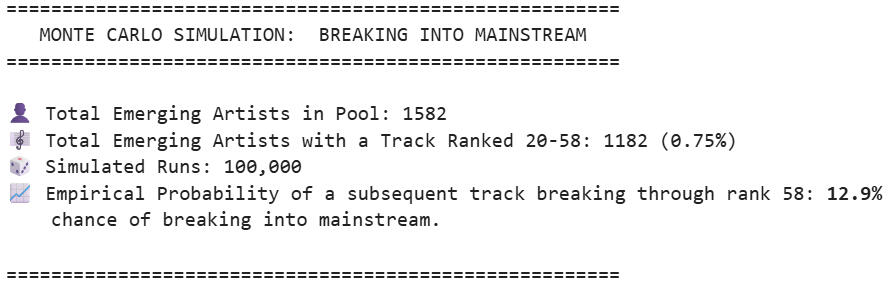
Question: What is the probability that an emerging artist, whose prior track peaked between 20 and 58, will produce a track that breaks into the top 58 to 100?
Mainstream: Artists who has released a track that rank between 58 to 80.
Total Emerging Artists: Artists who has released a track that rank below 58.
Sample Emerging Artists: Artists who has released a track that rank between 20 to 58.
Result: There is a 13% breaking into mainstream for emerging artists with a prior track ranked between 20 to 58.
Implications
Out of all emerging artists, 75% released a track that ranked between 20 and 58. However, only 13% of those who broke through the 20 barrier will break through the 58 barrier threshold for mainstream success. The difficulty rising stars face is not an isolated individual issue, but rather a structural flaw within Spotify's recommendation and discovery system. When recommendation feeds prioritize historical engagement metrics over content variety, it keeps superstar tracks entrenched at the top while gatekeeping new entries from emerging talent.
Key Findings
The Mainstream Threshold: An artist whose prior track peaked between a popularity rank of 20 and 58 faces a narrow 13% empirical probability of breaking through the rank 58 threshold and into the mainstream catalog.
Algorithmic Dominance: The top 15 established global artists command 30% share of high-ranking tracks (ranked between 70 to 100). The current recommendation algorithm heavily favors already established well-known artists (Taylor Swift, Bad Bunny, The Weeknd), slimming visibility for emerging talent.
Strategic Release of Singles: Spotify’s recommendation system rewards frequent, consistent content. Releasing individual tracks is less resource-intensive than album releases and keeps artists active in the algorithm.
Risks for the Spotify's Stability
Catalog Stagnation: Relying on a small pool of mega-hits leads to cultural stagnation and listening fatigue.
Loss of Trust: High structural barriers push disenfranchised emerging creators to migrate toward alternative digital distribution platforms.
Increased Vulnerability: Heavy reliance on a hyper-concentrated group of legacy stars weakens Spotify's bargaining leverage during high-stakes record label negotiations.
Recommendations (For Spotify)
Discovery Footprint: Introduce an internal structural constraint within personalized frameworks (e.g., Discover Weekly, Home Feed) to guarantee a fixed exposure footprint for emerging talent.
In-App Planning Calculator: Launch an automated release-cadence planner powered by historical metrics like drop-off thresholds, completion rates, and seasonal traffic spikes. Help emerging artists avoid competing at the same time as major label releases.
Recommender System Optimization (RSO): Provide a transparent analytics dashboard showing how close an artist's track is to triggering organic algorithmic pushes (e.g., "Your track has a 14% save rate; you need X more saves to unlock Discover Weekly visibility")
Expected Outcomes (why it matters)
Helping emerging artists break through using data and algorithmic tools rather than relying on luck transforms Spotify from just a streaming platform into an active engine for creator growth.
Spotify automates the burden of independent artists who do data analytics, tracking, and promotion on their own, allowing more time for creating music and touring.